Home Insurance for Solar Panels in Ireland
Installing solar panels changes the equipment permanently attached to your property. Before work begins, check how your existing insurer treats the panels: they may fall within buildings cover, but the position depends on the insurer and the policy. This guide explains what to ask, which documents to keep and what to check before comparing home insurance.
Are solar panels covered by home insurance in Ireland?
Permanently fitted rooftop solar panels are attached to the structure of your home, so they may be treated as part of the building under the buildings section of a home insurance policy. Whether they are, and on what terms, depends on how your particular policy defines the building and its fixtures, and on what your insurer agrees once it knows about the installation.
Some Irish insurers state in their published guidance that solar panels are included within buildings or premises cover. That is the position of those insurers, not a guarantee across the market. Policy wordings, underwriting criteria and the questions insurers ask all differ, so the reliable answer to whether solar panels are covered by home insurance is the one your own insurer gives you for your own policy.
Solar panels that are permanently fitted to your home may be treated as part of the insured building, but cover depends on the policy wording. Contact your insurer, confirm how the panels and the associated equipment are treated, and make sure your buildings sum insured remains appropriate.

Do you need separate solar panel insurance?
In most cases a homeowner would review or update their existing buildings insurance rather than buy a standalone solar panel insurance policy. The panels become part of the home, so the natural starting point is the policy that already insures its structure. This is a general position, not a promise that every insurer will provide the same cover or accept every installation on the same terms.
If your current insurer cannot provide suitable cover for the installation, you may need to compare other home insurance options, or discuss any specialist requirements with an insurance provider, for example where a system is fitted to a separate building or is not mounted on the house at all. Our main guide to home insurance in Ireland explains what else is worth checking when you compare cover.
Tell your insurer before installation
Contact your insurer before the work begins rather than after the panels are on the roof. Installation involves roof fixings and new electrical connections, and the finished system adds equipment to the property. Telling your insurer in advance is prudent: your policy may require you to tell your insurer about changes to the property, and insurers may ask about solar installations when you buy or renew cover. Under the Consumer Insurance Contracts Act 2019, you must answer the questions your insurer asks honestly and with reasonable care.
Questions to ask your insurer before installation
- Will the panels be included under buildings cover?
- Do you need details of the installation, and if so, which details?
- Are there any conditions relating to the installer or to certification of the work?
- Does the buildings sum insured need to change?
- How are the inverter and any battery treated?
- Are any specific exclusions or excesses relevant to the installation?
Ask for the answers in writing where possible, or note the date, who you spoke with and what was confirmed, and keep that note with your policy documents. If the solar installation is part of a wider project, our guide to home insurance during renovations and extensions covers what to tell your insurer while work is under way.
Solar panels and the buildings sum insured
Your buildings sum insured should reflect the cost of rebuilding your home, not its market value. Market value includes the site and its location, neither of which needs to be rebuilt after a serious insured loss such as a major fire. The rebuild cost is what it would take to reconstruct the property itself.
A solar installation adds equipment that would need to be replaced if the home had to be rebuilt or repaired after an insured loss. Ask your insurer whether your rebuild cost estimate and buildings sum insured should be updated to reflect the panels, inverter and any battery. There is no standard amount or percentage to add: the right figure depends on your property and the system installed. Our guide on how to calculate your home rebuild cost explains how to work out the figure, and our main guide explains how underinsurance can reduce a claim.
What parts of a solar installation should you ask about?
A solar PV system is more than the panels. Treatment can vary depending on where each component is installed, whether it is permanently fitted and how your policy defines the building and its fixtures, so it is worth asking about each part separately.
- Rooftop solar PV panels. The most visible part of the system, fixed to the roof.
- Mounting equipment. The rails, brackets and roof hooks that secure the panels and attach to the roof structure.
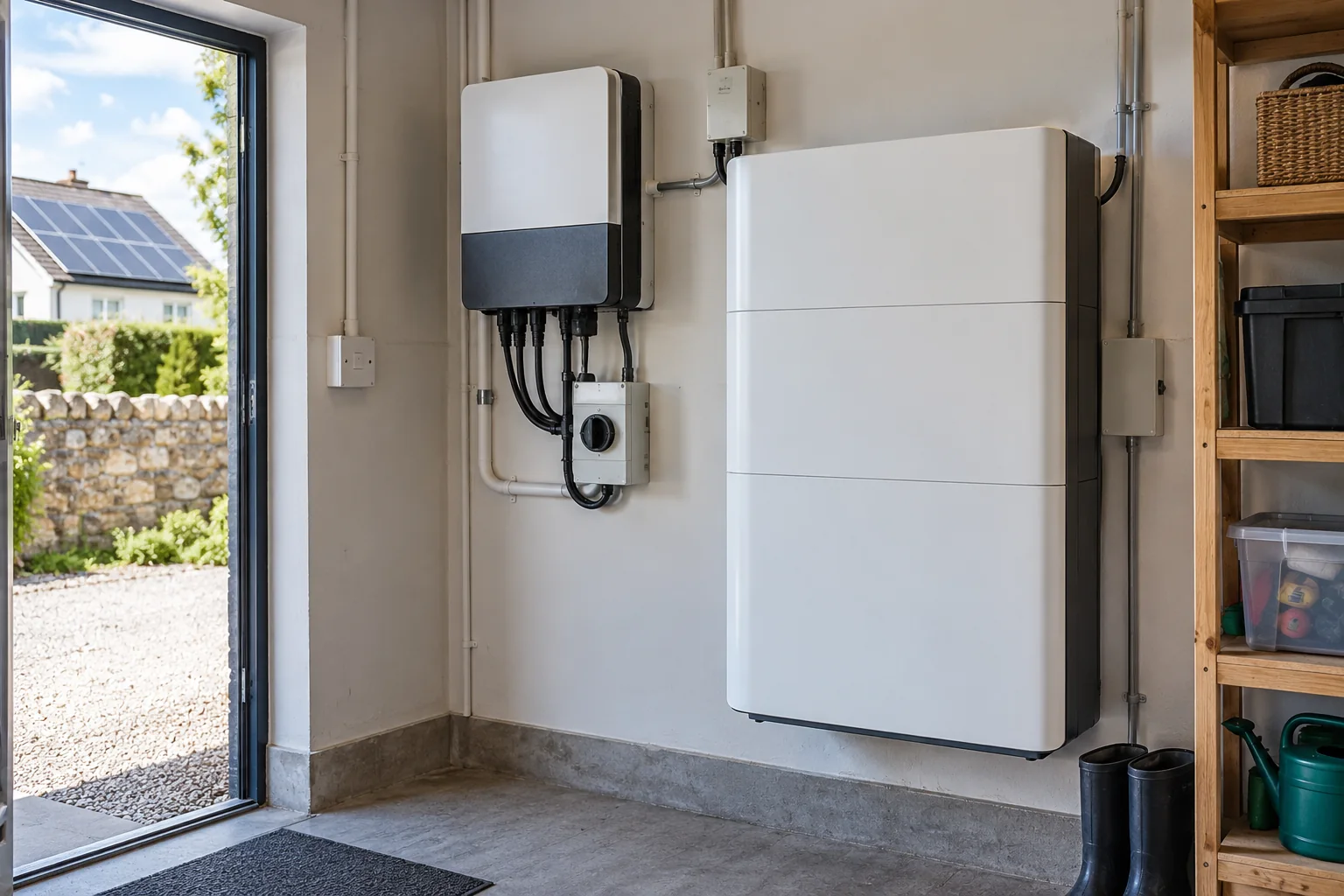
- Inverter. Converts the electricity the panels generate for use in the home, and is often fitted in the attic, garage or utility room.
- Cabling and permanently installed electrical components. The cabling, isolators and any changes made at the consumer unit.
- Home battery. A separate unit that may be fitted indoors or in a garage. See the battery section below.
- Associated monitoring or control equipment. Generation meters, monitoring hubs and controllers. Depending on the policy, some items may be treated as part of the building and others as contents.
- Detached garage or outbuilding installations. Panels or equipment on a garage, shed or other outbuilding may fall under a different part of the policy from the main house, so confirm how the outbuilding itself is covered.
Our guide to buildings and contents insurance explains how policies generally draw the line between fixtures and belongings, and our Solar PV guide sets out what a typical home system includes.
What types of damage might a policy cover?
Fire, storm, theft, vandalism and accidental damage are examples of risks that a home insurance policy may cover. Whether any of them applies to your solar installation depends on the insured events, exclusions and excesses in your particular policy. Solar panel storm damage, for example, would be assessed against the policy's own storm wording and conditions, and accidental damage is often an optional extra rather than automatic cover.
Wear and tear, gradual deterioration, mechanical breakdown, defective products, poor maintenance and faulty workmanship may be treated differently or excluded. Manufacturer and installer warranties are separate from home insurance. Do not assume a policy covers lost electricity generation or export income while a system is not working.
Installation damage and the installer's insurance
Home insurance is not a substitute for the installer's own insurance or its contractual responsibilities to you. If something goes wrong during the installation, or the work is not carried out properly, your contract with the installer and the installer's own insurance are central to resolving it, and a home policy may exclude faulty workmanship.
The CCPC advises consumers to check their home insurance policy before going ahead with major improvement works, and notes that insurers may consider whether work was carried out by an appropriately qualified professional. When you contract with a business for home improvement work, you also have rights under the Consumer Rights Act 2022.
For grant supported solar PV work, SEAI requires you to use an active SEAI registered Solar PV company. SEAI's scheme requirements for registered companies include holding specified insurance and meeting technical and Code of Practice requirements, and the Declaration of Works must be signed by a registered installer. SEAI registration is a scheme requirement, not an endorsement or a guarantee of workmanship, so compare quotations, contracts and warranties carefully.
Electrical work should be properly certified where required. Safe Electric states that a Registered Electrical Contractor must issue a completion certificate for electrical works, excluding minor works. Ask for your copy and keep it with your other installation records.
Compare home insurance for a home with solar panels
Compare cover, excesses and policy terms, then confirm with the insurer how your panels, inverter and any battery would be treated before you buy.
Solar batteries and home insurance
A home battery may not be treated in exactly the same way as rooftop panels. It is a separate piece of equipment, often installed indoors or in a garage, and policies can treat it differently depending on how and where it is fitted. Before a battery is installed, or when adding one to an existing system, confirm with your insurer:
- Whether it is covered as part of the building or under another policy definition
- Whether its location, such as a garage, utility room or outbuilding, affects cover
- Whether there are installation, ventilation, fire safety or certification conditions
- Whether the battery needs to be declared
- Whether your buildings sum insured should include its replacement cost
Your installer and the manufacturer's installation instructions determine where a battery can be fitted. Our guide to solar batteries explained covers sizing, warranties and the SEAI battery grant.
Buying a home that already has solar panels
If you are buying a property with an existing solar PV system, the system becomes part of the home you are insuring, so it is worth gathering the details before you arrange cover.
- Ask the seller for the installation and commissioning records, including the electrical completion certificate.
- Check the panel, inverter and any battery warranties, and whether they transfer to a new owner.
- Confirm who owns the equipment, particularly if any of it was leased or financed.
- Tell your proposed insurer about the system when you arrange cover, and answer its questions accurately.
- Make sure the rebuild cost estimate reflects the property as purchased, including the solar installation.
What to have ready when contacting an insurer
Having these details to hand makes it easier to answer an insurer's questions accurately, whether you are updating your existing policy or comparing new cover.
Documents and details to keep together
- Installation quotation or invoice
- Panel and inverter details
- Battery details, if applicable
- Installation address and where the equipment is located
- Installer details
- Completion and electrical certification
- Warranties
- Updated rebuild cost estimate, if requested
- Details of any financing, lease or ownership arrangement
What to compare in a home insurance policy
When you compare home insurance after installing solar panels, look beyond the price and check how each policy treats the installation alongside the rest of your home.
- The installation and buildings cover. Whether the solar installation is included within buildings cover.
- The buildings sum insured. Whether it reflects your rebuild cost with the installation in place.
- Relevant insured events. Which events the policy covers, such as fire, storm, theft and vandalism.
- Storm and accidental damage wording. How each is defined, and whether accidental damage is included or optional.
- Standard and risk-specific excesses. The standard excess and any separate excess for particular types of claim.
- Exclusions. How the policy treats faulty workmanship, wear and tear, breakdown and defective equipment.
- Batteries, inverters and outbuildings. How each is treated, and whether an outbuilding installation is covered on the same basis.
- Claims conditions. What documentation the insurer expects you to provide in the event of a claim.
- Overall buildings and contents cover. Whether the policy as a whole suits your home, not just the solar equipment.