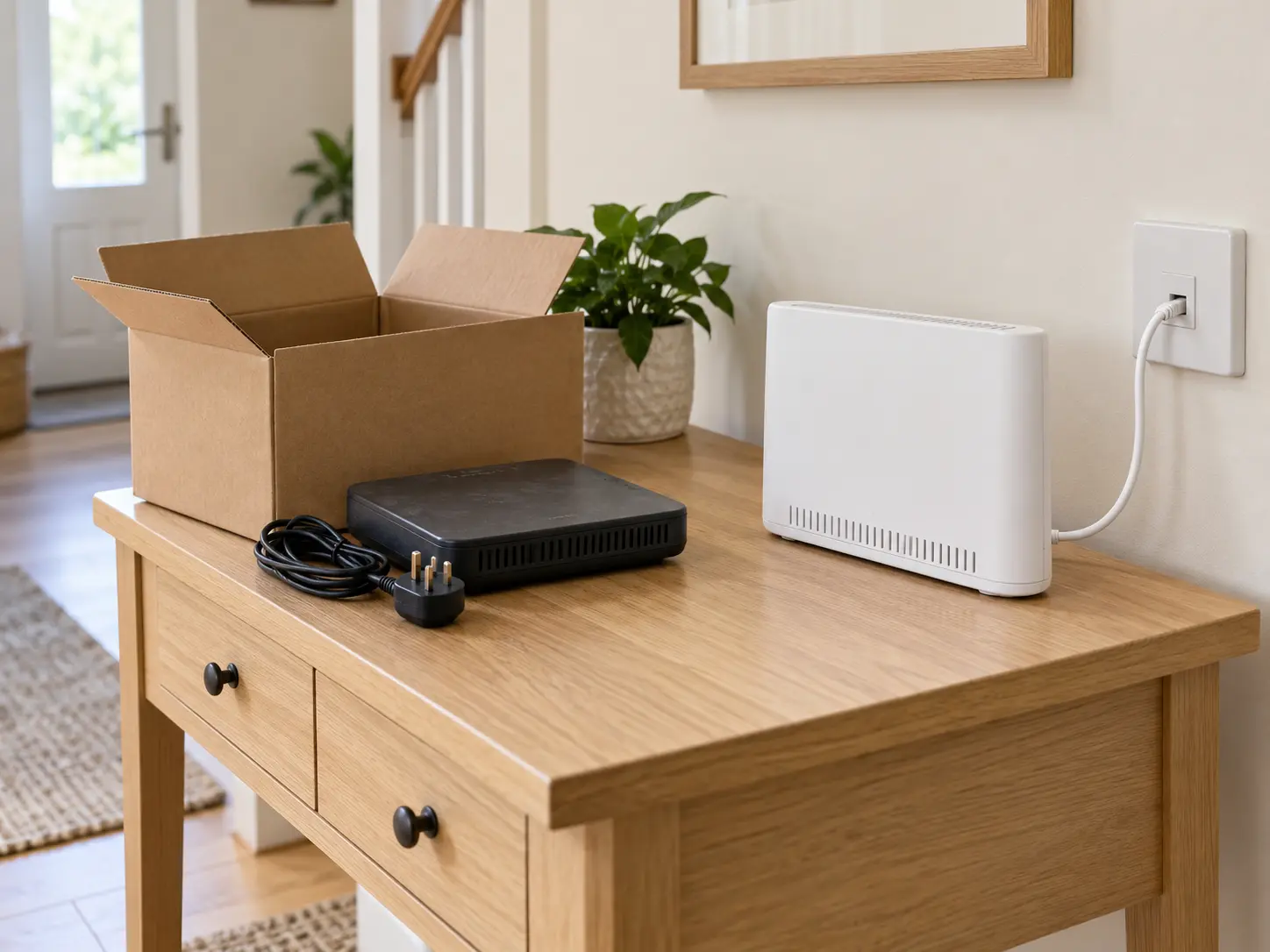
Broadband guide

Rural Broadband Options in Ireland

In rural Ireland, the broadband you can order depends far more on your exact address than on any national coverage claim. This guide explains how to find out what genuinely reaches a rural home, how fibre, fixed wireless, mobile and satellite broadband differ in practice, and what to compare before choosing one.

Why rural broadband depends on the exact address

Rural broadband is shaped by which networks have physically reached a property. A fibre route may pass one house on a road and not yet reach another a few hundred metres away, a mobile mast may give a strong signal on one side of a hill and a weak one on the other, and a farmhouse set well back from the road can have different options from a bungalow at the gate. Availability can genuinely differ between neighbouring addresses, so what a neighbour has is a clue, not an answer.
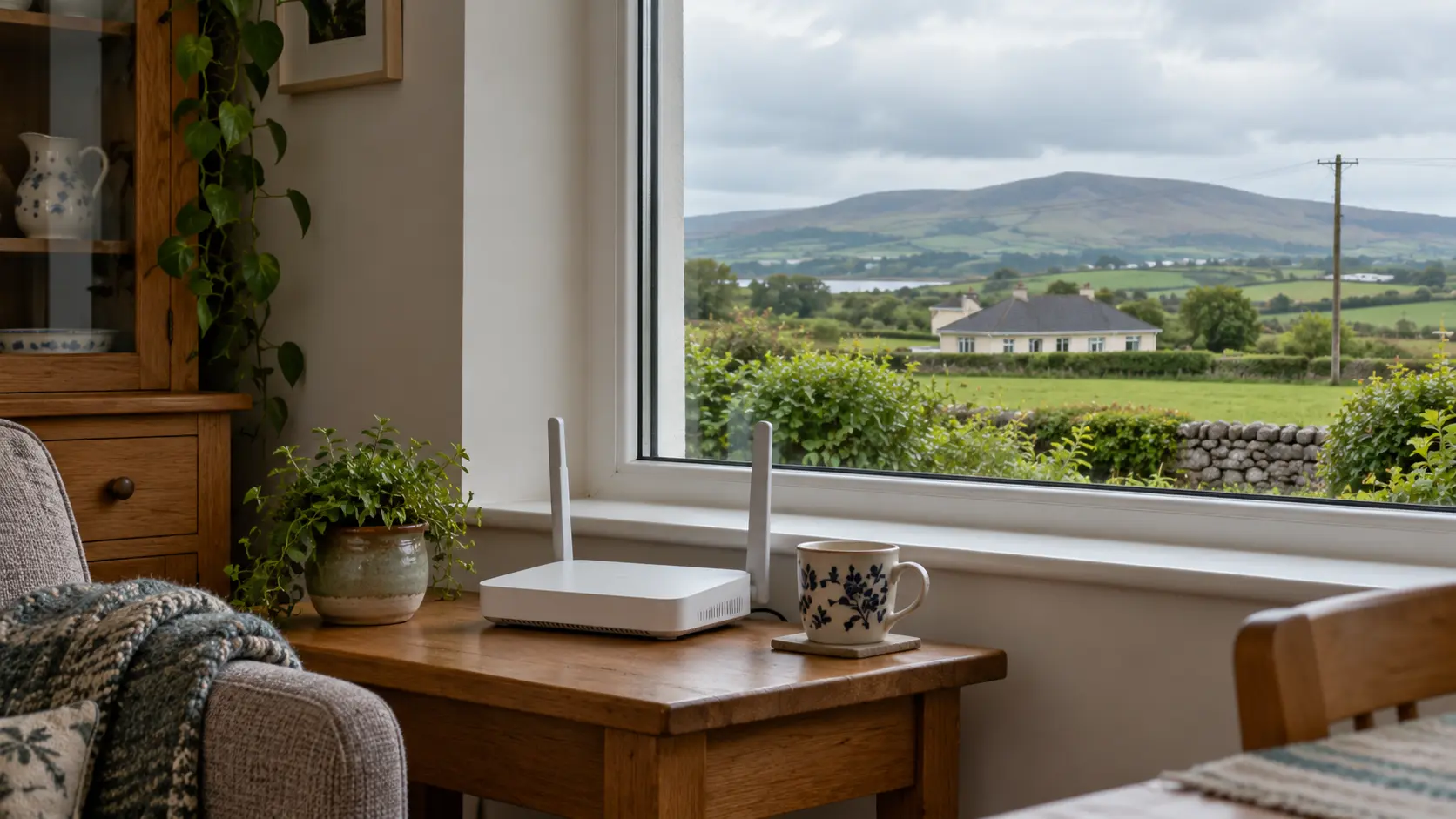
WiFi router in an Irish rural home

That is why this guide starts with the address rather than the plans. Our main guide to broadband in Ireland covers comparing plans, contracts and switching in general. This guide focuses on the question that matters most for a rural household: what is actually available at your address, and what should you compare before choosing between the options you have?

Start by checking the address or Eircode

An Eircode identifies an individual property, which makes it far more useful than a townland name or a pin on a county map. Before comparing any plans, use your Eircode, or the full address if you do not have one, in the checkers run by the networks that serve rural Ireland:

  • National Broadband Ireland. Its network map shows whether an address is in the National Broadband Plan area and the current status of the fibre rollout there.
  • Other fibre network operators. Open Eir and SIRO each have their own address checkers for the fixed line networks they operate.
  • Mobile network coverage. ComReg's outdoor mobile coverage map shows predicted outdoor 4G and 5G coverage by address or Eircode. It is a prediction, and signal inside a building can be weaker.

ComReg notes that its own broadband information tool does not cover fixed wireless, satellite or mobile broadband, so for those options you need to ask the providers directly whether they serve your address.

A network checker is the start, not the end

A network checker tells you which infrastructure reaches the address. You still need a retail broadband provider to offer a plan over that network at your address, so confirm availability with the provider before you rely on it.

What the National Broadband Plan intervention area means

The National Broadband Plan is the State's programme to bring high speed fibre broadband to premises where commercial operators were not expected to build it themselves. The premises covered are known as the intervention area, and it includes many rural homes, farms and businesses across every county.

National Broadband Ireland builds and operates the fibre network in the intervention area as a wholesale network. It does not sell broadband plans to households. Instead, retail broadband providers use the network to sell plans to customers, so a household in the intervention area chooses and contracts with a retail provider, not with National Broadband Ireland.

If your address is outside the intervention area, that usually means a commercial network was expected to serve it. It does not guarantee that a fibre connection can already be ordered there, so the address check still matters.

Being included in a rollout is not the same as being ready to order

An address can be inside the intervention area, or inside a commercial rollout plan, long before a connection can actually be ordered. Network checkers generally show a status for each address, such as whether work is planned, whether the fibre network has passed the property, or whether the address can now order a connection through a retail provider. The exact wording varies between checkers and changes over time.

For a household, the status that matters is whether you can order a connection today. Until it says so, compare the options that are genuinely available now, and keep the fibre status in mind when you consider contract length. Some network checkers let you register for an update when the status of your address changes.
The rural broadband options you may be offered

Rural addresses are most often offered one or more of four connection types. Our guide to full fibre, part fibre and mobile broadband explains the technology behind each in more detail. The summary below concentrates on what each means for a rural home.

Full fibre broadband in rural areas

Full fibre runs a fibre optic cable all the way into the property. In rural areas it may arrive through the National Broadband Plan network or a commercial network. Once connected, the performance of full fibre does not depend on the distance from a mast or cabinet, and upload speeds tend to be much closer to download speeds than on other connection types.

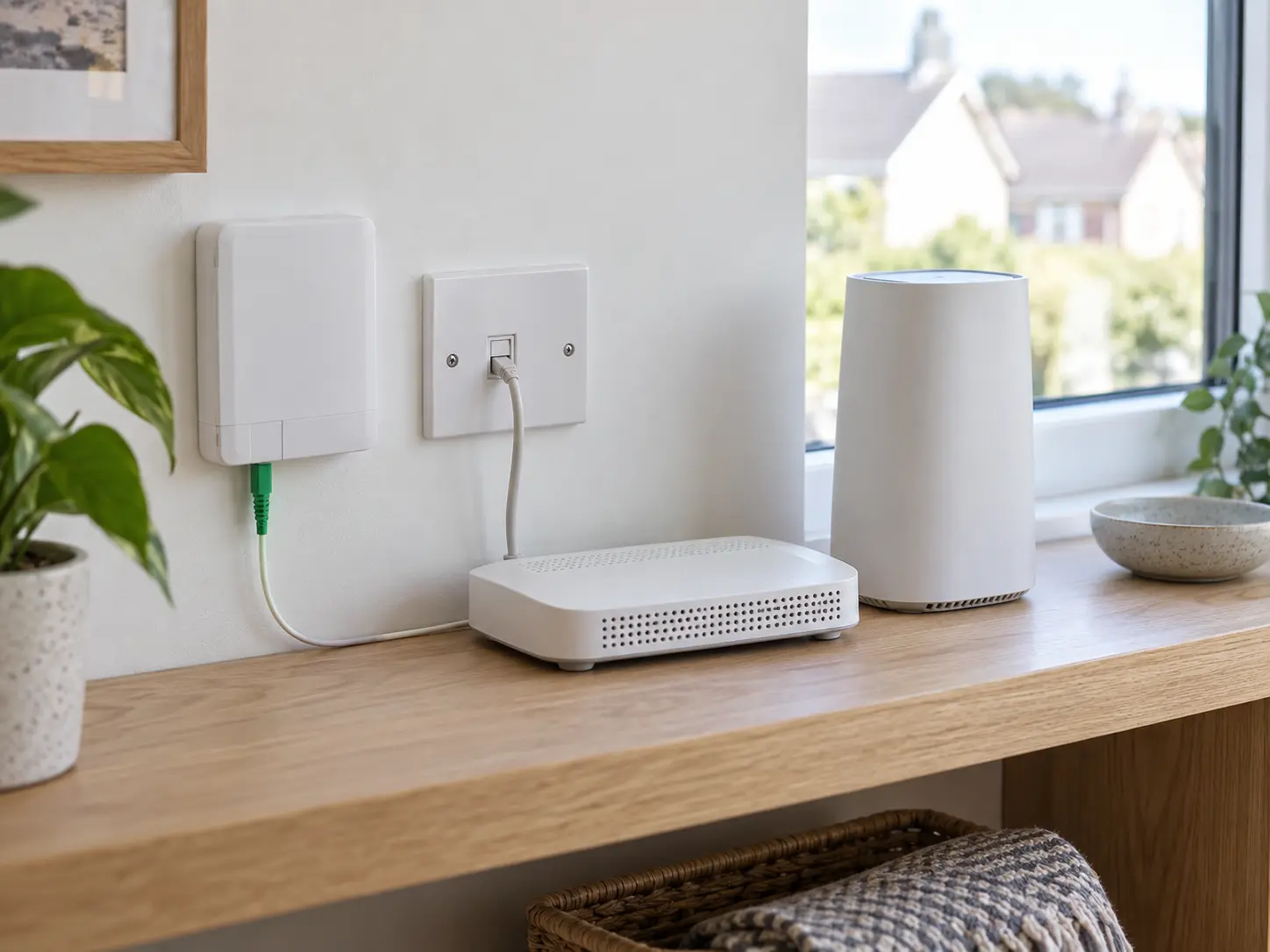
Installation usually involves running fibre from the nearest pole or underground duct to the house, then fitting a small network termination unit inside, and the router beside it. For a house set back from the road, ask how the fibre will reach the building, whether any work on your own land or ducting is needed, and who is responsible for it.

Fixed wireless broadband

Fixed wireless broadband delivers a connection by radio from a local transmitter to a receiver fitted on the outside of the property, usually needing a clear line of sight between them. It has long been used in rural Ireland where fixed lines did not reach. Performance depends on the distance and line of sight to the transmitter, local terrain and trees, weather, and how many customers share the transmitter's capacity at busy times. Ask about typical speeds at busy times, not only the maximum.

4G and 5G home broadband

4G and 5G home broadband uses a mobile network, received by a router inside the home, sometimes with an external antenna to improve reception. Where the signal is strong and the mast is not congested, it can be a practical option that needs little or no installation. Its performance, though, depends on signal at your specific property, local network capacity, walls and building materials, and where the router sits. A phone showing good signal outdoors is not proof of strong, consistent home broadband indoors.

Satellite broadband

Satellite broadband can reach addresses that no fixed or wireless network serves well. It needs a dish or terminal with a clear view of the sky, a power supply and a cable into the house. Latency, the delay as data travels to and from the satellite, can be higher than on fixed line connections, depending on the satellite system used, which can matter for video calls and online gaming. Equipment is often bought or rented up front, and plans can include data limits or priority data allowances, so read those terms carefully.

Rural broadband options at a glance (general characteristics, not a ranking)
Connection How it reaches the home Worth asking about
Full fibreFibre cable from a pole or duct into the propertyWhether the address can order now, installation route and lead time
Fixed wirelessRadio link to a receiver on the outside of the propertyLine of sight, typical speeds at busy times, upload speed
4G or 5G home broadbandMobile network signal to a router, sometimes with an external antennaIndoor signal, data limits or fair use, performance at busy times
SatelliteDish or terminal with a clear view of the skyLatency, equipment cost, data allowances, installation

None of these is the right answer for every rural home. The most suitable option depends on what is genuinely available at your address and how your household uses its connection.

Comparison callback

Want to talk through the options at your address?

Once you know which connection types reach your home, a member of the comparison team can call you about the broadband plans available there.

Download speed, upload speed, latency and consistency

Rural options vary more on these four measures than urban fibre connections do, so it pays to look at all of them rather than the headline download figure alone.

  • Download speed covers streaming, browsing and downloads.
  • Upload speed covers video calls, sending files and cloud backups, and is often much lower than download speed on wireless and satellite connections.
  • Latency is the delay before data starts to arrive. It matters for calls and gaming even when speed is high.
  • Consistency is whether performance holds up at busy times, in poor weather and across the day, which is a particular question for shared wireless capacity.

Your contract should set out the speed information for your plan, and ComReg explains what fixed and mobile broadband contracts must include. For how to judge what your household needs, see our guide to working out the broadband speed your household needs.

A high advertised speed also does not guarantee strong WiFi throughout the home. Thick stone walls, long or extended layouts and outbuildings such as a home office in a converted shed can all weaken WiFi, whatever comes into the house. Our main guide explains how to tell a connection problem from a WiFi problem.

Data limits and fair use conditions

Fixed line fibre plans are commonly sold without a data cap, though it is still worth checking. Mobile, fixed wireless and satellite plans can have a monthly data allowance, a fair use policy, or a priority allowance after which speeds may be reduced at busy times. A household that streams on several screens, downloads large game updates or backs up photos can use a lot of data in a month. Before choosing, check:

  • Whether the plan has a data allowance, and how large it is
  • What a fair use policy allows, and what happens if you exceed it
  • Whether speeds are reduced or charges added after a limit is reached

Equipment, installation and setup costs

Rural connections can involve more equipment and installation work than a standard urban switch. Depending on the connection type, that might mean a fibre connection run from the road, an external receiver or antenna on a wall or mast, or a satellite dish and mounting. Ask each provider about:

  • Any installation or connection charge, and whether it changes for a property set back from the road
  • Whether equipment such as the router, receiver, antenna or dish is included, rented or bought, and whether it must be returned at the end of the contract
  • The expected installation lead time, and what happens if an installer finds the property needs extra work
  • Who is responsible for any work on your own land, such as ducting or a pole

Broadband for working from home

Working from home makes a rural connection's weak points matter more. Video calls rely on upload speed, low latency and a connection that stays stable through the working day, not just in the evening. If you work from home, ask providers about upload speed and performance during the day, and consider where in the house you will work, since a wired connection or good WiFi in that room matters as much as the plan. If your employer has requirements for a home connection, check those too.

Broadband for streaming, video calls and gaming

Streaming mainly depends on download speed and, for heavy users, on data allowances. Video calls depend on upload speed and stability as well. Online gaming is sensitive to latency and stability, while large game downloads benefit from higher speeds and generous data. If gaming matters to your household, ask about latency directly, particularly for satellite and wireless options, rather than relying on the download speed alone.

Moving into a rural property

If you are buying or renting a rural home, check broadband before you commit, not after you move. Use the Eircode of the property in the network checkers, ask the current occupants or seller which connection they use and how it performs, and test mobile signal at the property itself, indoors as well as outside. Remember that what the previous occupant had, or what neighbours have, may not be what you can order. If a new installation is needed, ask about lead times early so you are not left without a connection for the first weeks.

For the steps involved in moving a service or starting a new one, see our guide to switching broadband provider in Ireland.

What to compare beyond the headline speed

Once you know what is available, compare the options on more than one number. For a rural household, the details below can make a bigger difference than a higher advertised download speed.

  • Upload speed and latency, as well as download speed
  • The speed information set out in the contract, and how consistent it is likely to be at busy times
  • Data allowances or fair use conditions
  • Installation charges, equipment costs and lead times
  • Contract length, any early exit fee, and how the price changes after an introductory period
  • Whether a shorter contract would make it easier to move to fibre once it can be ordered at your address

Our main broadband guide covers pricing and contract terms in more detail, including annual price increases.

What to have ready before comparing

Before you compare rural broadband

  • The Eircode of the property, and the result of your address checks
  • Which connection types appear to be available, and whether fibre can be ordered now or is only planned
  • How reliable mobile signal is at the property, indoors and outdoors
  • How your household uses the connection: working from home, video calls, streaming or gaming
  • Whether current problems happen everywhere in the home or mainly in certain rooms
  • Your current provider, contract end date and any early exit fee, if you have a connection already
Upgrader.ie original tool

Rural Broadband Check

Answer eight questions about the property and how your household uses its connection to see what deserves particular attention before you choose a plan. This is an educational starting point only.

Have you checked availability using the exact address or Eircode?
Which connection types appear to be available at the address?
Are you moving home or reviewing your current connection?
Where you have a connection now, is poor performance everywhere or mainly in certain rooms?
Do working from home or regular video calls matter?
Is streaming or gaming important?
Is mobile signal reliable at the property?
Is installation timing or equipment cost a concern?

Answer all the questions to see your personalised summary.

This tool gives general pointers based on the answers you enter. It does not check live availability at your address, does not access live broadband plans, does not compare every provider, does not quote or recommend a required speed, does not identify the cheapest plan, does not calculate savings and does not recommend a provider.

How the callback service works

If you would like help comparing the broadband plans available at your address, you can request a callback using the form below. Your details are passed to our comparison partner, Selectra, so a member of its comparison team can contact you. Available options depend on your address, and the plans discussed through Selectra's comparison service may not include every provider, plan or connection type available in Ireland. The form does not show prices or check availability itself; it only asks the comparison team to contact you.

Requesting a callback does not commit you to switching. For more about how the comparison service works, see Our Partnerships.

What happens if you choose a plan

If you decide to go ahead, you agree the plan with the retail provider, which confirms availability at your address and arranges any installation. Where a new connection is needed, an installation date is usually agreed with you, and some work may be needed outside the property. If you are moving to the new service from an existing one, the new provider can usually arrange the changeover, but check your current contract end date and any early exit fee first. Our guide to switching broadband provider explains the process.

Callback

Request a callback

Tell us what you would like help with and a member of the comparison team will contact you.

How it works

  1. Send your details using this form.
  2. A member of the comparison team will call you.
  3. Discuss the available options and decide whether any of them suit you.

Useful to have to hand

  • Your Eircode, so availability at your address can be checked
  • Which connection types your address checks showed
  • Your current provider and contract end date, if you have one

Fields marked with an asterisk (*) are required.

For example, 087 123 4567. Include the country code if it is not an Irish number.

By submitting this form, you agree that your details may be shared with Selectra so they can contact you about your enquiry. See our Privacy Policy.

Frequently asked questions

What broadband options are available in rural Ireland?

Depending on the address, a rural home may be able to order full fibre, fixed wireless broadband, 4G or 5G home broadband or satellite broadband. Not every option reaches every address, and availability can differ between neighbouring homes, so check your own Eircode with the network checkers and confirm with a retail provider what can be ordered.

How do I check broadband availability at a rural address?

Use the Eircode or full address in the network checkers, such as the National Broadband Ireland map and the Open Eir and SIRO checkers, and use ComReg's outdoor mobile coverage map for predicted 4G and 5G coverage. Then confirm with a retail provider that it offers a plan at your address, since a network checker alone does not confirm that a plan can be ordered.

My address is in the National Broadband Plan area. Can I order fibre now?

Not necessarily. Being in the intervention area means the address is included in the rollout, but a connection can only be ordered once the network checker shows that the address is ready to order. Until then, compare the options available today and keep the fibre status in mind when you choose a contract length.

Does National Broadband Ireland sell broadband to households?

No. National Broadband Ireland builds and operates the National Broadband Plan fibre network as a wholesale network. Households order a plan from a retail broadband provider that uses the network, and the contract is with that provider.

Is 4G or 5G home broadband a good option for a rural home?

It can be, where mobile signal at the property is strong and the local network is not congested, and it usually needs little installation. Performance depends on signal at your specific property, local capacity at busy times and the building itself, and some plans have data limits or fair use conditions, so check those before choosing.

What should I know about satellite broadband in Ireland?

Satellite broadband can reach addresses that other networks do not serve well. It needs a dish or terminal with a clear view of the sky, equipment can involve an up front cost, and latency can be higher than on fixed line connections depending on the satellite system. Check data allowances, equipment costs and latency before choosing.

Will a faster plan fix slow WiFi in some rooms?

Usually not. If the connection is fine near the router but weak in certain rooms, the problem is more likely to be WiFi coverage inside the home, which thick walls, long layouts and outbuildings can affect. Router position or a mesh WiFi system is more likely to help than a faster plan.

Does Upgrader.ie compare every rural broadband provider?

No. Upgrader.ie is an independent information resource, not a price comparison website. We do not show live prices or availability, compare every provider or connection type, identify a cheapest plan or recommend a provider.

Next steps

Ready to compare the options at your address?

Have your Eircode and the results of your address checks to hand, then request a callback to talk through the broadband plans available.